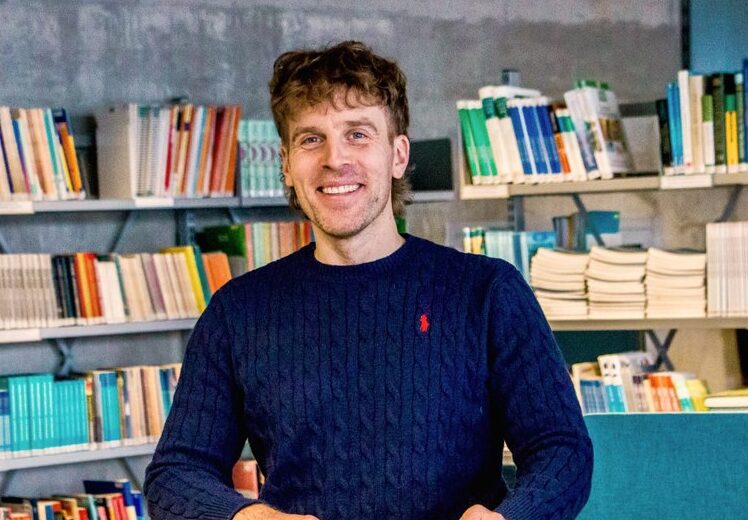
Rainer Mere has spent his career trying to understand what makes mental health interventions actually work. Now, as a visiting Fulbright scholar at The University of Texas at Austin, he’s found himself living inside his own research question.
Mere, an Estonian psychologist and doctoral researcher from Tallinn University in Estonia, is spending the 2026–27 academic year at The University of Texas at Austin as a Fulbright Visiting Student Researcher. He will be working with researchers in UT Social Work, studying why community programs for depression and suicide prevention take hold in one place and go nowhere in another.
“It is a privilege to welcome a Fulbright scholar to our community, and I know that our faculty look forward to meaningful collaborations and opportunities for mutual learning,” said Allan Cole, dean of UT Social Work. “We welcome Rainer Mere to UT Social Work, strengthening our ties to our colleagues in Estonia and beyond.”
Mere’s path to Austin began in practice rather than research. He worked as a school psychologist and in private clinical practice in Estonia, then led workplace mental health at a telecoms company and later at Twitter. From there he moved into European Union Horizon-funded project work on depression and suicide prevention, and eventually into doctoral studies to examine more rigorously what he had spent a decade doing in the field.
Through the project, Mere led the Estonian arm of a multi-country consortium, managing how the program reached the ground and studying the process as it unfolded. What the work showed him was that the interventions that succeeded were almost always community-based, and that whether a program worked had less to do with how well it was designed than with whether the people meant to deliver it actually picked it up. That insight, paired with a growing conviction that depression is a health issue rather than a personality flaw, led him to doctoral studies on how these programs fare once they leave the drawing board.
That pursuit took him to Tallinn University, and ultimately, the Forty Acres.
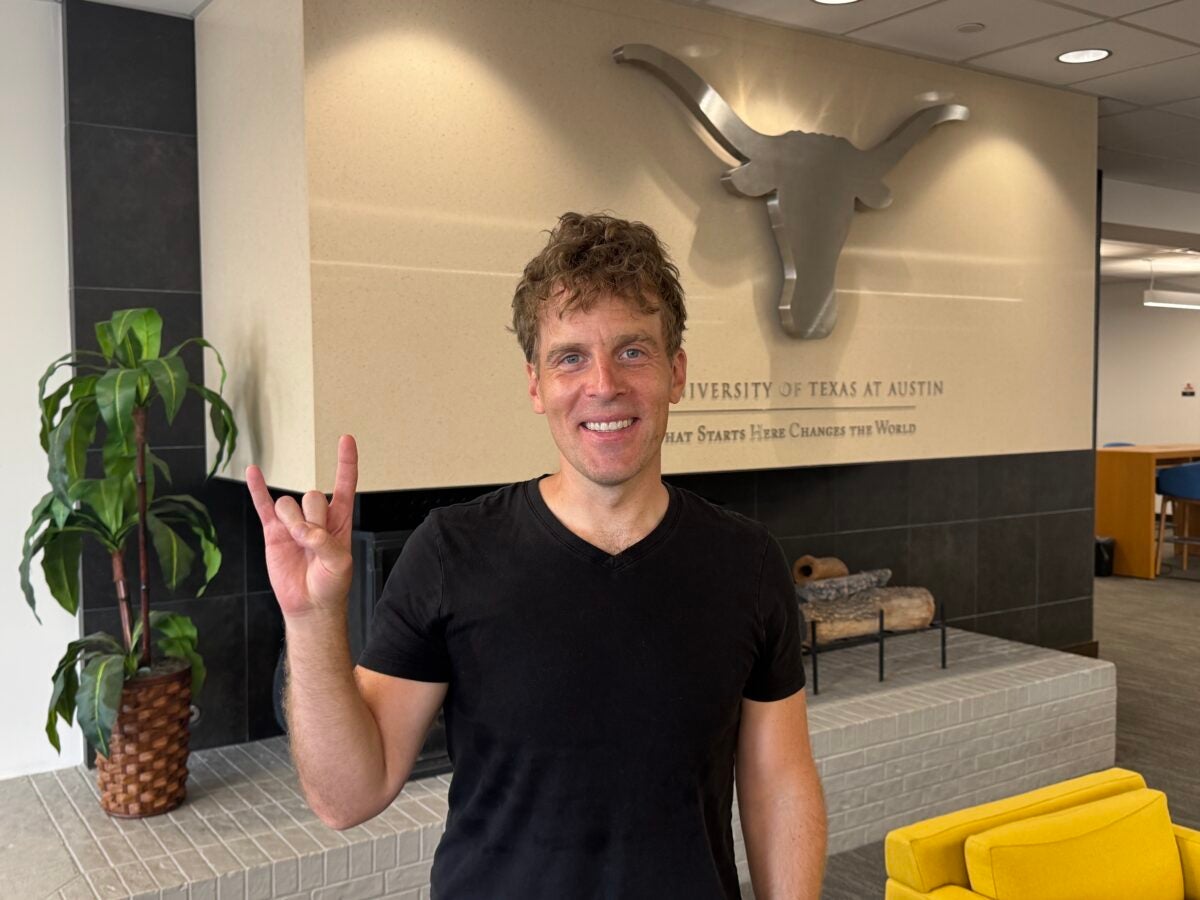
A Relationship with Tallinn University Continues
Mere first set his eyes on Austin after a conversation with his Tallinn supervisor, Merike Sisask. After initially considering an international study program in Germany or France, he became connected with Diana DiNitto, the Cullen Trust Centennial Professor in Alcohol Studies and Education and Distinguished Teaching Professor at UT Austin.
DiNitto, a long-time collaborator with Tallinn University and scholar with Estonian connections, became a major champion in advocating for Mere’s placement in Texas. She drew on those relationships in Estonia to guide Mere to the Forty Acres.
“Our school’s relationship with Tallinn University in Estonia continues to grow,” said DiNitto. “After visits last spring from Drs. Merike Sisask and Karmen Toros, two of Estonia’s outstanding researchers, we are delighted to be hosting Rainer, who is one of Dr. Sisask’s doctoral student mentees. I am excited about being involved in these connections that strengthen social work’s impact in addressing such important global issues.”
Sisask, who visited UT Social Work in April as part of a global engagement initiative, described the UT community as “welcoming” with a significant research opportunity that spans continents. She came away from her visit enthusiastic about the working relationships and atmosphere she encountered at UT Social Work, and Mere decided to “take the full plunge” into Texas.
Research Collaboration In Motion
His research plans center on suicidology in the United States, particularly in Texas, where he intends to bridge his practitioner’s background with the country’s academic research landscape. He’ll also be working alongside Lauren Gulbas, a researcher who has visited Estonia and whose qualitative methods complement his own quantitative training. Where his instinct is to initiate (such as asking questions, proposing ideas, and reaching out for connections) he sees Gulbas and DiNitto as veteran collaborators whose expertise he’s eager to learn from directly.
He intends to build on initiatives from Europe such as the MENTBEST program, an EU-funded inititive that aims to promote mental health during times of rapid societal change. Mere intends to assess it as an intervention and scale it up to be more effective. The program across its various country iterations aimed to equip practitioners such as teachers, social workers, police, first responders with digital tools, leaflets, and trainings to support community mental health. In Tallinn, where Mere ran it, that meant training more than 1,400 people across some 30 professional groups, from police officers and teachers to hairdressers, clergy and football coaches.
However, the tools only mattered if practitioners actually used them.
“Community intervention fails if there is no community,” Mere said, adding that building that community starts with getting the right people to say yes.

Adjusting to Life in Texas
Speaking of getting the right people to say yes, Mere is quick to note that the decision to come to Texas did involve getting buy-in from his family. He worked out possibilities with his wife on a move to the State, and as she began to process a move to America as a real plan rather than a passing thought, she began to come around to the idea. His son also grew steadily more excited as their departure date approached, eager to try American life firsthand.
“We took a risk, but as my wife says, this will be a terrific adventure for us all,” Mere said. His high-school-aged son is settling into his courses at McCallum High School. “I definitely dove in, and it’s been just an incredible experience.”
Mere’s early days in Texas have been logistical as much as academic. Adjusting to Austin has brought its own small lessons, such as sales taxes only appearing at checkout. He’s settled in the North Loop with his family, where he’s made his own community with neighbors and colleagues.
Follow His Story
In order to document his own story, Mere writes a newsletter chronicling his time in America — partly for himself, partly for those following along from Estonia.
In it, and in his research, he’s come to see himself as something of a case study: a person deliberately relocating into a new community to test the very question his work has always asked. Not simply whether someone has a disease, but whether they’re thriving and whether that thriving can be rebuilt in an unfamiliar place.
“I’m 100% sure I made the right choice already,” he said. “I don’t feel like an outsider. I feel like I belong here.”