

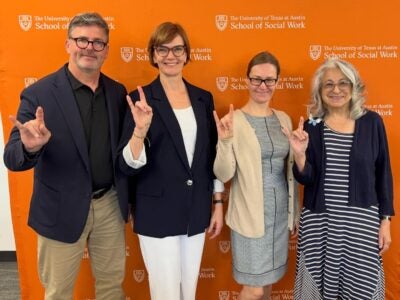
On April 8, two prominent Estonian scholars visited The University of Texas at Austin’s School of Social Work to share their research and reflect on the evolution of social work in Estonia since the country’s restoration of independence in 1991.
The guest lectures are a part of a multi-year research and teaching collaboration between UT Social Work and Tallinn University, which grew out of a decade-long partnership with UT Social Work professor Dr. Diana DiNitto. She first traveled to Tallinn in February 2014 to teach research and policy to doctoral students, and has taken an additional six trips to Estonia to teach and collaborate on research efforts.
Her colleagues from Estonia made the journey to Austin through an Erasmus grant partnership between UT Austin and Tallinn University. Tallinn University is responsible for educating all social workers in Estonia across BSW, master’s and doctoral programs — a staff of 13 serving the entire country. Two of those colleagues, Dr. Merike Sisask and Dr. Karmen Toros, spent time with UT Social Work sharing what they’ve learned in their partnership and research in Estonia.
Dr. Sisask, professor of social health care at the School of Governance, Law and Society at Tallinn University, opened with her talk, “Creating Mental Well-Being: A Collective or Individual Action.” Her research spans mental health and well-being in communities, the everyday digital lives of children and young people, and suicide studies. She also serves as a Council Member of the Centre of Excellence for Well-Being Sciences EstWell and a Board Member of the Estonian-Swedish Mental Health and Suicidology Institute.
Sisask described mental health as a continuous process of adaptation shaped by living environment and individual life choices — and argued that many of its determinants lie outside the healthcare system. Estonia, she noted, faces a shortage of mental health specialists, and Estonians are more likely to seek a psychiatrist or clinical psychologist when self-care falls short rather than turn to community resources. Social workers, she said, serve as important gatekeepers — able to recognize mental health challenges and connect people to services, even in the absence of clinical social work as a formal role in Estonia.
Estonia’s suicide rate has dropped significantly — from a peak in the early 1990s of 40 per 100,000 to 14 per 100,000 today — and the country launched a suicide prevention program within the last year. Still, Sisask noted, the rate has stabilized at what she described as a high level.
Dr. Toros, professor of social work at Tallinn University and founder of the Center for Advanced Research on Integrity, Rights and Inclusion of the Child — a collaboration between Tallinn University and Oslo Metropolitan University — followed with her talk, “Listening to Children: Rethinking Participation in Practice.”
Toros described her work as emerging from a realization that children, and often families, were not active participants in their own assessments. In Estonia, 14,213 children were identified as in need in 2024, with 1,056 in care. Calls to the Child Helpline continue to increase annually, alongside the growing complexity of cases involving mental health challenges, family instability and unequal access to services.
She noted in her core argument that children need protection, but not from participation. Listening must lead to influence, participation must be relational, and professionals need support to make it happen. “In this digital world,” she said, “children communicate differently.” She also emphasized that child well-being depends on worker well-being — and that child social work is among the hardest professions for a social worker.
The talk was sponsored by the UT Social Work Office of Global Engagement, which offers students and faculty opportunities for global research, global academic exchange programs, and global practicum education.