

When Joe Tate describes E4Texas to people, he keeps it simple: you build confidence, you find yourself, and you know you can do more.
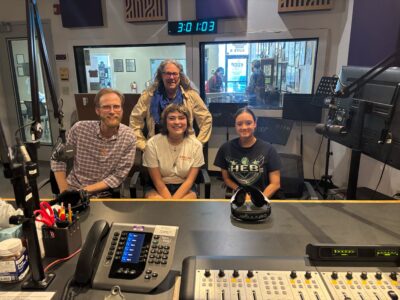
Tate, program director of E4Texas at The University of Texas at Austin, made that case to a wider audience last February when he and two current students — Emily and Katelyn — appeared on the ArtSparkTX Radio Hour on KOOP 91.7 FM. The weekly show, hosted by Art Spart Executive Director Celia Hughes, highlights information and advocacy by and for the disability community through arts-inspired viewpoints with local and state people and organizations. The conversation with Joe, Emily and Katelyn covered the program’s structure, the students’ paths to UT and what it means to live and learn on a major research university campus.
E4Texas is a three-semester vocational training program housed within the Texas Center for Disability Studies, part of UT Social Work. It serves adults 18 and older who hold a high school diploma and are ready to build careers. Students live on campus, complete internships across Austin and work toward caretaker certification in early childhood education, paraprofessional support or personal care. The program’s name reflects its four goals: educate, empower, employ and excel.
Emily found E4Texas at a disability job fair in fall 2024, more than a year after graduating from Leander High School and struggling to find work. She nearly missed it — the E4Texas recruiter was packing up her booth when Emily and her mother caught her.
“It sounded way too good to be true,” Emily said on air. “And then we went home and did the research, and it was true and it was good.” She’s now interning with Imagine Art and Meals on Wheels while auditing an animal studies course.
Katelyn learned about the program through Texas Workforce Commission while still in high school. She was uncertain at first but said the connections she’s made on campus have been worth it. She’s now interning at the Priscilla Pond Flawn Child and Family Learning Laboratory, working directly with children.
Students also audit a UT course each semester alongside degree-seeking students. E4Texas coordinates a learning contract with the professor beforehand — outlining goals and accommodations — to better fit student needs. “In high school, you’re entitled to accommodations and modifications,” Tate explained. “When you get to college, you cannot modify content.”
E4Texas students are on Canvas, held to what they commit to at the start of the semester, just like their peers.
For Emily, that accountability has been one of the program’s most valuable lessons. “I’ve learned so much just being truly independent,” she said. “If I do something wrong, it’s because I did something wrong.”
For more information, visit disabilitystudies.utexas.edu/E4Texas.