

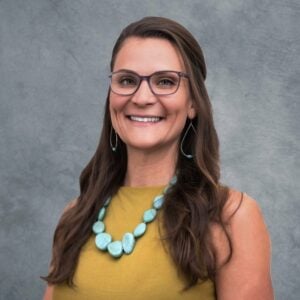
Lauren Lanehart is a doctoral student at the University of Texas at Austin School of Social Work whose research focuses on justice-involved youth, with particular interests in developmental pathways, individual and socioecological resilience, structural adversity, and assessment and intervention. She is particularly interested in how young people’s strengths, lived contexts, and experiences of adversity and resilience can inform more accurate assessment and more precise, effective intervention.
Her methodological interests include mixed methods, engaged research, grounded theory, and profile analysis. Her developing program of research seeks to better understand heterogeneity among justice-involved youth, including meaningful differences in strengths, needs, adversity, resilience, and context, and how those differences may inform assessment, intervention development, and intervention matching. Her current work also examines intervention mechanisms and contributes to research on how resilience is conceptualized and measured among youth involved in the legal system.
At UT Austin, Lauren serves as a Graduate Research Assistant with the Health Behavior Research and Training Institute (HBRT), where she works with Drs. Danielle Parrish, Kirk von Sternberg, and Mary Velasquez on CHOICES intervention research focused on bundled health-risk reduction and gender-responsive care for justice-involved youth. Her work includes data analysis and manuscript development examining change processes and intervention mechanisms, as well as intervention adaptation and study development, with primary responsibilities on CHOICES-Teen and CHOICES4Boys. She also collaborates with researchers from the University of Kentucky, Boise State University, and the University of Michigan on a multi-institutional study examining how resilience is conceptualized and measured among youth involved in the legal system.
Lauren also served as a Graduate Research Assistant with the Center for Resilient Communities at the UT Austin School of Social Work, working with Dr. Mary-Ellen Brown of UT Austin and Dr. Dana Hunter of Louisiana State University on research, training, and community-engaged initiatives focused on community resilience, childhood traumatic stress, Community Health Worker training, and systems serving youth and families. Her scholarship also extends to graduate social work education, including research on evidence-informed practice instruction, experiential learning, course evaluation, professional identity development, and digital storytelling pedagogy. She currently serves as a Graduate Assistant for Faculty Affairs with Dr. Brown.
Before beginning her doctoral studies, Lauren earned her Master of Social Work from Texas Christian University, where her research included federal youth workforce policy and evaluation of the Bystander2Upstander sexual-violence prevention program. Her practice experience includes clinical assessment, individual intervention, crisis response, and program evaluation with youth involved in juvenile justice and school systems. She is a Licensed Master Social Worker and Trust-Based Relational Intervention (TBRI)® Practitioner.
Lauren entered social work following a 15-year career in the United States Air Force, retiring at the rank of Master Sergeant. Her military career spanned intelligence and language analysis, diplomatic and cross-cultural operations, leadership, resilience programming, suicide intervention and prevention, and organizational initiatives addressing sexual violence, discrimination, and inclusion. These experiences continue to inform her commitment to research and education that are responsive to the people, communities, and systems they are intended to serve.