

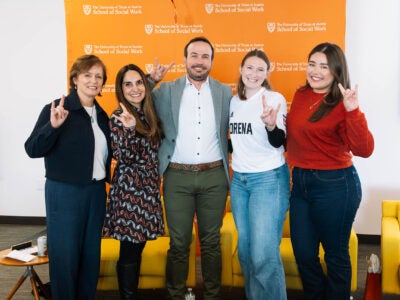
Stephanie Guevara, Social Work Council president, spent last summer in Greece building a calisthenics center for young men in a refugee camp. She was part of a Projects with Underserved Communities (PUC) team, and on Nov. 17 she joined faculty and fellow students at an Office of Global Engagement event to talk about 17 years of social work and engineering collaboration.
Since 2009, PUC has sent student teams to communities in developing countries. Taught in partnership with the Cockrell School of Engineering, PUC is a yearlong course. Teams of up to eight students spend nine months researching and designing a project with input from the community and a local partner organization. They raise funds for materials, then travel in the summer to finish the build and complete the project. To date, teams have served 18,300 people with projects that include clean water access, sustainable cooking stoves, health clinics, community libraries and sanitation.
The same community partners return year after year, so each project builds on the last and helps the community grow its own capacity. Teams pair engineering expertise with social work’s habit of listening, so what gets built serves a purpose.
Farya Phillips, Ph.D., CCLS, research assistant professor in the School of Social Work, said that pairing is the point. “These interdisciplinary teams solve complex problems that one profession alone could not tackle.”
The problems come with real constraints. Budgets, materials, fundraising and managing expectations all land on students, and every role matters. Students also learn to run a productive meeting with a tight agenda and clear outcomes.
Madison Palmer, a BSW student who traveled to Costa Rica in 2025, said experiences like this are why she’s drawn to organizational social work. “PUC targets every level of social work, from individuals to communities to systems.”
Tanya Voss, assistant dean for the Office of Global Engagement, and Gregory Rulifson, humanitarian engineering program director in the Walker Department of Mechanical Engineering, joined Phillips, Palmer and Guevara on the panel.
Four projects are planned for 2026-27:
- Greece: The team returns to restore a soccer field and recreational center.
- Costa Rica: Two teams will build a multipurpose sports court for games and community gatherings, and a classroom at an elementary school that adds a third more instructional space.
- Mexico: The team will build a storage space for mesquite pods to support the local economy and create jobs.
Information on how to donate to current projects is on the PUC website.
“You are sharing the same goals [with the engineering students], but as a social work student you bring in the community perspective,” Guevara said. “Advocacy starts in settings like this.”