

When a detective new to the Zebulon Police Department in North Carolina noticed that she was interacting with more juveniles than she had at her former agency, she began digging into its call data, and found a clear pattern emerging.
From 2012 to 2022, there was a 106% increase in children committing crime and 45% increase in children who were victims or witnesses to a crime or trauma. Additionally during this time, Zebulon was also seeing tremendous growth — the town saw an 87% increase in overall population, making it the second-fastest growing town in the state.
As part of a response to this data, the department partnered on a year-long fellowship with New Blue, an organization that works with officers to create solutions and problems that undermine community trust. The department decided to launch a social work unit embedded in the police department to work with children, and through a New Blue micro-grant, the CARE Unit (Community Advocacy & Resource Enhancement) was created.
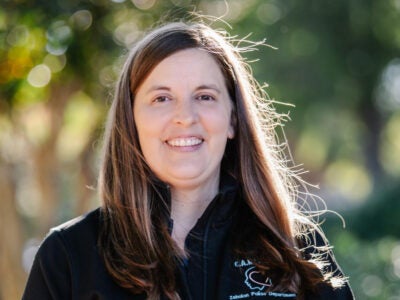
The CARE Unit is now led by Emily Edwards, LCSW (MSSW ’09). Hired in October 2025, she was the first social worker hired full-time for the department. With a trauma-informed framework, Edwards is the face of change in public safety, working in preventing calls to law enforcement by empowering families with appropriate resources.
“We have seen firsthand the value that social work brings to public safety,” said F. Edwin Killette, Criminal Investigations Division Captain at Zebulon Police Department. “While integrating social workers into law enforcement is becoming more common, what sets Zebulon’s CARE Unit apart is its dedicated focus on juveniles who have experienced trauma, whether as a witness, victim, or offender.”
Most of Edwards’s referrals come from officers on patrol. A report comes in, such as a child witnessing a traumatic event or a household is in crisis, and Edwards follows up. During her visits, she connects the family to counseling services, medical care, food resources, school support, and/or domestic violence protections. She also continues to follow up with families as they request, ensuring that solutions are implemented and effectively being used.
Edwards is very careful to draw a clear line between her work and the role of law enforcement. Her role, she says, is to help families navigate systems to get families “the resources they need in the way they actually need it.”
“Social work is not an extension of the police,” Edwards said. “It’s a community support that police don’t have the capacity to fill. My job is to help understand why the call was needed in the first place and put in the supports so that a family won’t feel that they’re in a situation where the only option is to call the police.”
Edwards helps parents understand their rights around numerous systems, including school district resources, juvenile justice, and mental health services. She works with parents and caregivers to understand programs such as IEPs and victims’ rights giving them the ability to advocate for their own children rather than simply handing over a list of phone numbers.
Nearly two years after the start of the CARE Unit program, the results have been measurable. Zebulon Police reported a sharp rise in referrals since social workers joined the department. Fifteen referrals a month jumped to 15 referrals a week as officers have grown more attuned to recognizing when a family would benefit from social work support. Community surveys have also shown an increase in people reporting a more positive view of law enforcement after working with the CARE Unit.
“By embedding social workers within our department, we connect youth and families to critical resources while providing early intervention before problems escalate. The impact on our agency has been substantial, and we are already seeing how our social workers are improving outcomes for youth in our community,” said Killette.
Edwards, raised in North Carolina, traces her success in social work back to her education on the Forty Acres. She spent her own practicum experiences at Con Mi Madre, then at Seton Family of Hospitals (now Ascension Seton). Both internships, she said, gave her the foundational skills she needed to jump start her social work career. She also now mentors social work students herself, as a field instructor while impacting lives in Zebulon.
“Your practicum is such a critical part of your education,” she said. “That’s where you build your foundational skills and discover how to effectively support people. I serve as a field instructor now because of the positive experience I received. If I train someone well, I know that I can count on them as a future social work colleague.”
After graduating from UT Social Work, Edwards went into the school system, where she began to work closely with school-aged children and their families.
Police social work continues to be a fast-growing field, with more jurisdictions bringing mental health professionals into their departments. Edwards hopes to see more social workers in the profession, and says for social workers drawn to kids, families, and tangible impact, the role is “a natural fit.”
“You get to support families during some of the worst days of their lives,” she said. “It is very rewarding to assist a family to improve the life of a child.”