

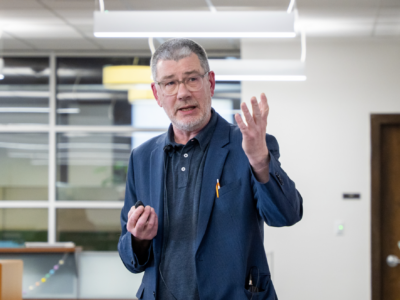
When Paul Hutchinson greeted the audience at his “Dividing (up) the Peace” event on Tuesday, February 24, he did so in Irish — offering one hundred thousand welcomes to a room full of students, faculty, staff and community members. It was a fitting opening for a conversation about radical hospitality, the power of narrative and what it means to build peace in divided societies.
The event, organized by the School of Social Work’s Office of Global Engagement, brought together students, faculty, staff and community members for a wide-ranging conversation about radical hospitality, the power of narrative and what it means to build peace in divided societies.
Dr. Noёl Busch-Armendariz, the Associate Dean of the Office of Global Engagement, said of the ongoing partnership with Hutchinson, “Our partnership with Paul and colleagues in Northern Ireland reflects our conviction that peacebuilding knowledge travels; it is not confined by geography. Communities that have endured sustained conflict develop hard-earned insight into harm, reconciliation, and repair. Through ongoing exchanges, we strengthen our collective capacity to navigate division with wisdom, responsibility, and humility.”
Hutchinson, a therapist, artist, filmmaker, mediator and retreat leader, grew up in Belfast during the Troubles — the three decades of conflict in Northern Ireland that claimed approximately 3,500 lives between 1969 and 1998. He later served as director of Corrymeela, Ireland’s oldest peace and reconciliation center, founded in 1965 by Ray Davey, a Presbyterian minister and former prisoner of war who witnessed the bombing of Dresden.
Through images, poetry and an interactive presentation, Hutchinson guided the audience through questions that lingered long after the conversation ended. Can you make a new horizon? What does it mean to let the land do some of the recovering? “No one ever got wet reading a book about the ocean,” he observed — a reminder that peacebuilding, like healing, requires presence, not just knowledge.
In conversation with Dean Allan Cole, Hutchinson explored reconciliation, storytelling and the hard work of holding space for opposing views. He also reflected on Uvalde, drawing parallels between communities navigating life after violence and Northern Ireland’s long road since the Good Friday Agreement.
“Conflict reduces us to the level of the hurt,” he said. “And we realize we are more than the hurt.”