

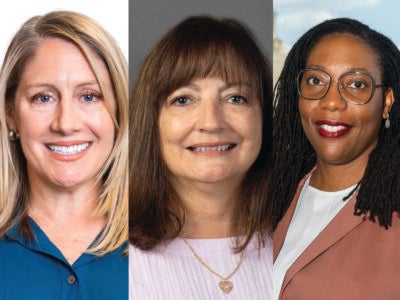
UT Social Work’s leading researchers shaped the national conversation on social work education. This week, we’re sending our experts to the 71st CSWE Annual Meeting in Denver, where across nine different sessions, our faculty, staff, and students will share research that bridges policy and practice.
On Friday, Oct. 24, we’re hosting “Office Hours” at booth #510 — a pop-up think tank for exchanging ideas on research, education, and impact. Three leading researchers will share insights on what’s working, what’s emerging, and what’s next in the field.
Danielle Parrish opens UT Social Work’s “Office Hours” at CSWE with insights on fetal alcohol spectrum disorder
Up first on Friday the 24th, Danielle Parrish will speak at 11:30 a.m. on fetal alcohol spectrum disorder and her CHOICES-TEEN research, which is focused on reducing substance-exposed pregnancies among adolescent girls in the juvenile justice system.
Dr. Parrish is the Steve Hicks Professor in Addictions and Substance Abuse Services and associate director of the Health Behavior Research and Training Institute. Her current work centers on prevention strategies for young women who are involved with juvenile probation — a population often overlooked in public health efforts.
“Research clearly identifies young women who become involved with the justice system as presenting with multiple overlapping health and behavioral health risks, providing an opportune time to intervene using efficient, individualized bundled prevention interventions that are developmentally and youth informed,” Parrish said. “Developing and testing efficient gender-responsive interventions for higher-risk young women, given their distinct risk profiles, and translating these interventions into the real world has great potential for improving the future health trajectories of these young women. “
In her career, Dr. Parrish has served as principal investigator or co-investigator on projects funded by the National Institutes of Health, Centers for Disease Control and Prevention, and the Health Resources and Services Administration. She is editor-in-chief emerita of the Journal of Social Work Education, where she served as editor-in-chief from 2020-2025, and a research scientist with SEARCH Homeless Services in Houston.
UT Social Work “Office Hours” at CSWE continues with Sandy Magaña on culturally relevant tools for disability interventions
“Office Hours” continues Friday afternoon with Sandy Magaña at 2 p.m., presenting on culturally relevant tools for disability interventions. She’ll share insights from her work adapting parent training programs for Latin American families of autistic children.
Dr. Magaña is a professor of autism and neurodevelopmental disabilities and serves as the executive director for the Texas Center for Disability Studies housed at UT Social Work. Her research explores the cultural context of families caring for individuals with disabilities.
“What we’ve seen in family and parenting dynamics is that not all interventions are one-size-fits-all,” Magaña said. “Being able to take evidence-based solutions and apply it in a culturally relevant way is a critical part of properly caring for individuals with disabilities, as well as their families and caregivers.”
Her current projects include investigating racial and ethnic disparities among children with autism and developmental disabilities. Her work is supported by the National Institute of Mental Health, National Institute on Aging, National Institute of Child Health and Human Development, and the National Institute on Disability, Independent Living, and Rehabilitation Research.
Her recent work in Ecuador, Paraguay, Argentina, and Latino communities in the U.S. continues to inform her research and programming at the Texas Center for Disability Studies.
Fiona Conway wraps up UT Social Work “Office Hours” at CSWE with a presentation on the use of smartphone apps in substance use recovery
“Office Hours” wraps up with Fiona Conway at 3 p.m., presenting on smartphone apps and substance use recovery. She’ll explore how digital tools can support recovery for individuals with physical disabilities — especially when in-person care isn’t accessible.
“Making interventions accessible for all populations should be a foremost priority for social workers, and that especially is true for any intervention that uses digital means,” said Conway. “App accessibility is one of the most important conversations we should be having in this space. I’m excited to share findings we’ve discovered at UT Social Work and how my work informs this knowledge.”
Dr. Conway is the Ruby Lee Piester Centennial Fellow in Services to Children and Families and the associate director of research at the Addiction Research Institute, one of 10 scholarly centers and research institutions at UT Social Work.
Her research focuses on substance use behaviors, with an emphasis on recovery support services, digital health solutions, and youth substance use. She also collaborates with biomedical scientists to explore the intersections of behavioral health and human biology.