

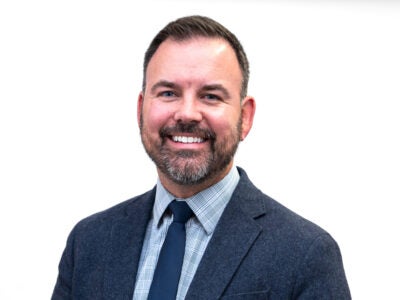
The School of Social Work at The University of Texas at Austin announced that Robert Sebesta, LCSW-S, HEC-C (MSSW ‘02), will join its faculty as a clinical assistant professor in health and aging.
Sebesta brings more than 20 years of social work clinical experience to the clinical faculty at UT Social Work, as well as experience as a health care ethicist and psychotherapist. His areas of interest include health care ethics, integration of faith and psychotherapy, moral injury, and professional identity formation.
“Ethics are essential in social work,” said Allan Cole, dean of UT Social Work. “Professor Sebesta’s experience as a health care ethicist and related expertise will strengthen what we offer students and helps position us as a leader in this space. His contributions will impact our work in health, behavioral health, and leadership, especially in the realm of caring for aging adults.”
As a former lead health care ethicist at the VA National Center for Ethics in Health Care, Sebesta provided ethics consultation, education, and policy analysis to address complex ethical issues arising in patient care. Prior to that, he managed the ethics program for the Central Texas VA, while also providing evidence-based psychotherapies for combat veterans with PTSD. Additionally, he worked as a clinical social work supervisor at Austin State Hospital, where he also served as chair of the ethics committee.
Sebesta holds a Master of Science in Social Work from The University of Texas at Austin. In 2015, he was one of two VA healthcare professionals competitively selected to participate in a joint ethics fellowship at the University of Chicago MacLean Center for Clinical Medical Ethics. He has delivered presentations on health care ethics topics at local, regional, and national conferences and has published in a scholarly social work and bioethics journal.
“Returning to my alma mater as a full-time professor is a tremendous privilege and honor,” Sebesta said. “Social work values diverse beliefs, which helps our profession to navigate ethical challenges and conflicting values in an increasingly complex world. This is particularly relevant to the aging population, where technological advances in health care often raise quandaries about how one ought to proceed with care. I am eager to share my knowledge and experience with students, collaborate with fellow faculty, and help develop ethical leaders committed to the well-being of others, promoting more kindness in the world.”