

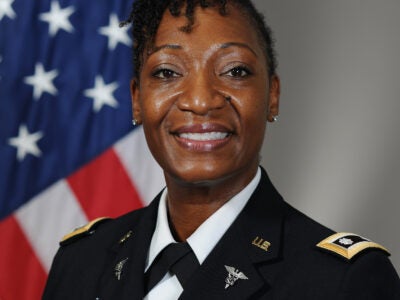
COL. Dr. Lataya Hawkins (Ph.D. ’21), LCSW-S, BCD, has been appointed Dean of the Graduate School at the U.S. Army Medical Center of Excellence (MEDCoE) at Fort Sam Houston in San Antonio — a role that places her at the helm of one of the most comprehensive allied health education systems in the military.
A doctoral alum of The University of Texas at Austin School of Social Work, Hawkins now oversees 13 graduate programs in partnership with three universities, including the MSW program with the University of Kentucky and the physician’s assistant program with the University of Nebraska Medical Center. Baylor University also confers degrees in healthcare professions through the center. Every program ranks in the top 15% nationally, according to US News and World Report.
Her appointment is a milestone for military social work — and a moment of pride for UT Social Work.
Hawkins enlisted in the Texas Army National Guard in 1990 as a medic and later commissioned as a military intelligence officer. After earning her MSSW from the University of Houston, she transitioned into the Medical Service Corps as a social work officer. She was mobilized shortly after for the Global War on Terrorism, serving at Fort Belvoir, Virginia, and later at Walter Reed Army Medical Center. Her career spans a deployment to Iraq, and a one-year assignment to Korea, various leadership roles in behavioral health, and a two-year fellowship in Child and Family Practice.
In November 2024, Hawkins was promoted to full colonel in the United States Army — joining an elite group of only 10 full colonel social workers across the entire Army. Her promotion reflects both her distinguished service and the growing recognition of social work as a strategic leadership discipline within military healthcare.
Her doctoral research at UT Austin focused on moral injury — a concept still emerging in military circles. Moral injury occurs “when individuals behave in ways that go against their moral code,” she explained, citing examples such as harming the elderly, women or children as part of war. Her research highlighted historical practices like cleansing ceremonies among Native American tribes, which helped warriors reintegrate into their communities. She noted that “individuals with moral injury trauma have higher rates of suicidal ideations and suicides than individuals with threat to self or others trauma” and emphasized the importance of leadership preparing soldiers for the moral trauma often associated with combat, particularly the “struggle to reconcile behavior with who you believed you were.”
Hawkins leads a system designed to prepare future allied health professionals to care for the operational force — from prolonged care in war zones to managing their own anxiety in combat while caring for our warfighters. “Our role is to train the Army’s future allied health professionals,” she said, “We get our Ph.D.s and doctorates to come back to the school house to train our own.”
In the military, allied health professionals are clinical social workers, physician assistants, registered dietitians, hospital administrators, anesthesia specialists, and rehabilitation therapists trained to deliver care in high-pressure environments, including combat zones and field hospitals, often with limited resources and under extreme conditions.
She also leads with a service mindset, encouraging a culture of shared purpose. In November, her team will volunteer with the Fort Sam Houston Vogel Resiliency Center to distribute food to military-affiliated families. “To whom much is given, much is required,” she said. “We need to operate as a team, have dialogue about what we’re working on, and lift each other up.” Always asking, she added, “How do we bless others?”
Reflecting on her time at UT Social Work, Hawkins recalled a moment of humility and growth. “Dr. (Cynthia) Franklin told me (I was an LTC), ‘The hardest thing for you will be that you’ve already had a level of success in the Army, but you will be a student here. How will you accept that and find success?’” she said. “I had to figure out who I was without the security of my uniform.”
She added, “My relevancy doesn’t come from the uniform — it comes from how I show up in the world. The impact you make on the world.”