

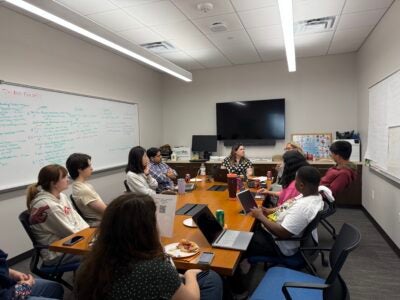
The University of Texas at Austin School of Social Work launched a new course this spring — Digital Health and Health Technologies — bringing a timely focus on AI, emerging technology and their implications for social work practice.
Instructor Melanie Sage, Ph.D., a national leader in technology and social work education and co-author of the CSWE bestselling text Teaching Social Work with Digital Technology, designed the course to move students from passive technology consumers to informed, confident contributors in digital health spaces.
Students examine and compare chatbot tools — including emerging platforms designed for therapists and social workers — evaluating features such as privacy, transparency and real-world usability. They also assess ethical dilemmas and equity considerations raised by health technology, develop strategies to influence organizational and policy-level decisions, and build frameworks for ethical, evidence-based technology use in practice.
As clients gain access to wearables and other self-monitoring tools, social workers need to meet them there — asking informed questions about the technology they’re using, helping them evaluate options and integrating what they learn into care plans.
“Technology is only as valuable as the humanity behind it,” said Allan Cole, dean of UT Social Work. “This course prepares our students to bring ethical analysis to spaces where it’s needed most — asking hard questions, advocating for clients and shaping technology that serves the common good.”
Using Microsoft tools supported by the UT System (including UT Spark, the University’s generative AI platform), students will design and test chatbots built for specific social work contexts. As part of this project, students select training documents, navigate copyright and ethical considerations, develop guardrails to redirect people to human supports when needed, address the needs of varied users, and work to minimize risks such as inaccurate outputs. They are testing their own apps and each other’s against structured ethical and best-practice criteria.
This semester, one student group in the class is developing a chatbot that helps people who are experiencing homelessness find immediate local resources for food and shelter. Another group developed a chatbot that helps clients identify and express their most pressing biopsychosocial needs.
“Social workers often see ourselves as passive consumers, or not knowledgeable enough about tech to help build or inform it,” Sage said. “But social workers bring something engineers often don’t: deep understanding of the people these tools are meant to serve. If we opt out due to discomfort with technology, others who may be less knowledgeable or hold different values will fill those spaces. I want students to leave this course feeling empowered — able to ask better questions, spot harm before it spreads and advocate for technology that puts people first.”
Sage is a familiar face at UT Social Work. In Fall 2024, she held a lunch and learn program at the DiNitto Career Center to teach students how to ethically apply AI. She also presented during AI Live, the University’s week-long, campus-wide exploration of artificial intelligence and its implications across disciplines.
The new course reflects broader momentum at UT Social Work around technology and practice. The School’s Working Group on AI and Other Technologies brings together faculty and staff to navigate the intersection of social work education, practice and emerging technologies. The Moritz Center for Societal Impact’s Health and Technology program has also been active in this space — researchers Elisa Borah, Ph.D., and Jillian Landers, Ph.D., recently shared findings from a national survey on AI use in social work, conducted in partnership with the National Association of Social Workers.
“AI is here to stay, and we expect technologies like this to continue shaping the practice of social workers,” said Rebecca Gomez, Ph.D., associate dean for academic affairs. “This new course keeps the human experience front and center as we prepare future social workers to evaluate technology critically and use it responsibly.”