

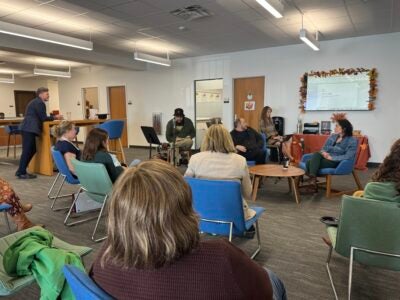
For the final Verses & Voices session of the Fall 2025, members of the UT Social Work community collaborated in songwriting and connecting with themes on understanding language, setting boundaries and preventing burnout as clinicians.
Andy Langer, program director for the Moritz Center for Societal Impact, interviewed clinical assistant professor Mayan Herman, LCSW on a range of topics, including her bilingual background and her journey to becoming a professor in Texas. A musician herself, Herman serves as a practicum liaison at UT Social Work and teaches bachelor’s and master’s level students.
Herman noted through the interview that she particularly enjoys working with bachelor-level students, teaching them initial ways to practice “realistic” self-care. She noted that the way students and clinicians talk about self-care has significantly evolved over the last decade, with strategies to prevent burnout taking a much larger role in mentorship.
“We used to say things in self-care like ‘Take a bath and you’ll feel better!’ but that doesn’t solve your problems when you have to go back to a job that’s stressing you out,” Herman said. “Learning to see self-care as a connection to why you do the work you do as opposed to an individualistic or short-term ritual is so important to addressing burnout.”
Herman also noted that individuals asking for help can also experience significant burnout, particularly if they need to use a translator or have to see multiple agencies. Herman used the example of a non-English speaker attempting to find healthcare assistance, only to miss connections with case workers or be misunderstood by doctors. When a case worker can connect to a client in a language that is directly understood, Herman said, the individual and the system become more efficient, resulting in a better overall societal outcome.
The session closed with a songwriting exercise led by artist-in-residence Travis Foster. Using an acoustic guitar in a B-flat key, Foster collaborated with the audience to develop a series of verses and a chorus. The song exercise resulted in a song that addressed combatting anxiety and stress caused by burnout by “building bridges” to connect with others.
“Social workers don’t and won’t stop – and that’s extremely motivating to me,” Herman said to the group. “Music is the same way. No matter what system we’re fixing or what relationships we’re connecting, music and social work aren’t ever going anywhere.”