

International Education Week continues with a look at Dr. Diana DiNitto and her decade-long partnership with Estonian scholars.
What began with an unexpected email in 2014 will now bring two prominent Estonian researchers to Texas this spring — and has fundamentally shaped how Professor Diana DiNitto understands resilience.
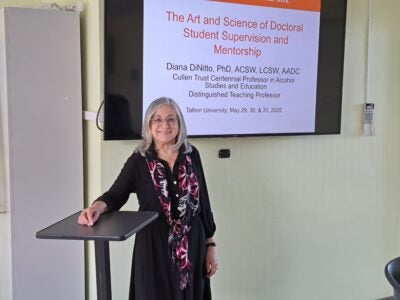
Professor Diana DiNitto opened that email — a call for someone to teach in Tallinn University’s social work doctoral program — and thought, “I have nothing to lose by applying.” The time was right for a new adventure. Then the invitation arrived: Come to Estonia in February.
“February in Estonia is not exactly balmy,” DiNitto jokes about her first trip to the Baltic nation. I borrowed a real winter coat and bought some snow boots.
Building connections through doctoral education
DiNitto taught policy and research to doctoral students from multiple countries during that semester in 2014. The experience sparked connections that have endured across six visits and more than a decade.
The partnership has produced a tangible impact. DiNitto co-supervised a dissertation that received a national award from the Estonian Research Council — the first time a social work student had received that top recognition. The research, focused on improving disability assessment systems, moved beyond theory to influence how Estonia assesses people with disabilities for services.
“It was more than theoretical,” DiNitto says. “It helped define the assessment system for disability.” The student balanced her research with work and a young and growing family. She now works in Estonia’s national government and teaches at Tallinn University.
Estonia: A nation forged through resilience
Estonia, one of three Baltic nations with a population of 1.37 million — roughly Austin’s size — regained independence in 1991 following the “Singing Revolution,” a series of events from 1987 to 1991 when hundreds of thousands of Estonians gathered to sing forbidden patriotic songs, using their rich choral tradition as a peaceful protest against Soviet occupation.
Following the restoration of independence, social work revitalized and grew across the Baltic states — a transformation DiNitto witnessed firsthand through her colleagues’ work.
On April 8, two of DiNitto’s Estonian colleagues will present at UT Social Work as part of an Erasmus grant partnership between Tallinn University and UT Austin — the first time the Estonian faculty have visited Texas.
Merike Sisask, Ph.D., a public health researcher specializing in mental well-being and suicide prevention, and Karmen Toros, an expert in child protection, will discuss their work and the evolution of social work since the restoration of independence. Afterwards, Dean Allan Cole will host a reception.
For DiNitto, the partnership reinforces how much social work has to contribute across the globe. “Seeing social work thrive following Soviet occupation, seeing students successfully defend their dissertations and make their own contributions — I am so glad I answered that email.” In 2022, Tallinn University awarded Professor DiNitto an honorary doctorate.
The Estonian visit on April 8 brings DiNitto’s exchange full circle: scholars she has collaborated with in Estonia now sharing their expertise with Texas faculty, staff, and students. Social work is needed everywhere, DiNitto says, but the systems we build to deliver it are shaped by each country’s unique history.