

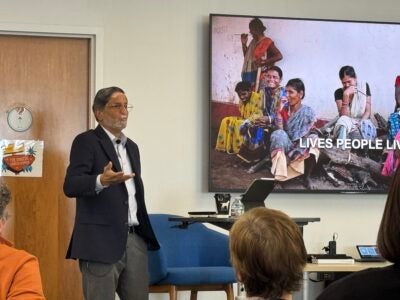
Dr. Gautam Yadama, dean of the Boston College School of Social Work, visited UT Social Work to meet with faculty, staff and students and share insights on his research in social work.
Yadama, a scholar who understands poverty and environmental dynamics, leads research on interventions to improve social, economic, environmental, and health outcomes. As part of his visit, he delivered a guest lecture to the Texas Social Work community on how he engages communities in designing and scaling interventions from practice to frameworks.
“The days of describing and explaining problems without moving to interventions are over,” Yadama said, emphasizing the need to see the non-linear narratives that communities face. “These communities are taking risks at the margins with very vulnerable lives. They are solving problems at the margins and are not looking for solutions from others. My motivation is to remember that at all times.”
Yadama shared his experience in research around the globe, including Rwanda, Sierra Leone, Bangladesh, and Guatemala. He also shared how those studies helped inform domestic research and how policies can impact lives.
“When we do work globally, it equally informs our work locally,” he said. “Our local work iterates globally. There is no firewall. Global and local communities all deal with similar challenges. Solutions can be translated.”
All research, whether local or international, must begin with the lives that people live, Yadama said. By deeply embedding into the way people conduct, solve, and engage in decision making, he said, social work researchers can find actual answers and a vision in research.
He closed his lecture by encouraging interdisciplinary work among academics, sharing some of the work he’s done with engineers, medical professionals, psychologists and other academic domains. By doubling down on the practice side and reaching deeply into fundamental research, Yadama said, researchers can use design thinking to translate it to the real world to achieve large-scale effects.
“Privilege the problem, not the discipline,” he said. “Only then can you re-center research on the human condition.”