

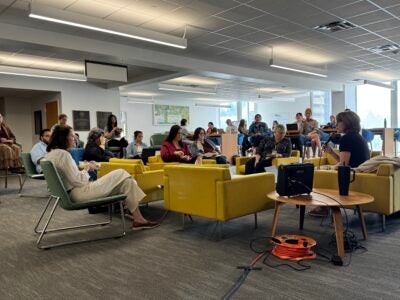
Robin Smith, LCSW-S, clinical associate professor and coordinator for the Social Work Practice in Substance Use Disorders Certificate, launched UT Social Work’s new Clinical Sessions Lunch & Learn series with an interactive discussion on psychedelic-assisted therapy.
Smith shared information and insights from a recent six-day seminar through the University Psychedelic Education Program designed to foster professional development, personal growth and community building through didactic and experiential learning.
As a faculty fellow with U-PEP’s inaugural training cohort, Smith is bringing this emerging knowledge to faculty and students who will educate patients, policymakers and communities. UT Austin is the only Texas university represented in the program.
“I am a curious skeptic when it comes to psychedelic-assisted psychotherapy,” she said. “We need to be familiar with it and educate our students about it.”
Understanding neuroplasticity
The promise of psychedelics lies in their ability to promote neuroplasticity. Certain compounds, such as psilocybin, MDMA and ketamine, can have hallucinogenic, entactogenic or dissociative effects, respectively, which can reset neural circuits. As a result, patients can process emotions and memories in new ways, guided by psychotherapy.
It is one piece of a comprehensive approach to therapy that shows particular promise in patients dealing with conditions such as treatment-resistant depression, PTSD and anxiety.
The McGill Center for Psychedelic Research & Therapy at Dell Med launched in December 2021 to study psychedelics for the treatment of depression, anxiety and PTSD with an initial focus on military veterans living with post-traumatic stress disorder, adults experiencing prolonged grief disorder or depression, and those who have experienced childhood trauma.
Texas leads research efforts
Texas is at the forefront of this shift. Governor Abbott signed SB 2308 on June 11, 2025, authorizing the state to invest $50 million in clinical trials for ibogaine, a psychedelic with potential to treat opioid use disorder, traumatic brain injuries and PTSD, particularly in veterans and first responders.
Texas has the nation’s largest veteran population — about 1.6 million — with more than 250,000 living in Central Texas. Many face lasting mental health challenges from their military service, making this research particularly urgent.
As this complex field evolves to address some of our most challenging mental health conditions, faculty like Smith are ensuring UT Social Work students stay at the forefront of evidence-based practice.