

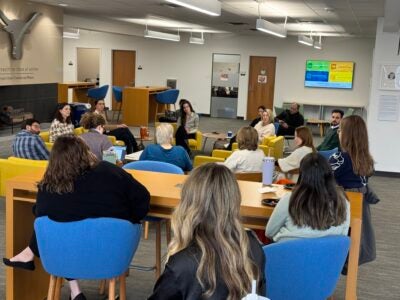
The Moritz Center for Societal Impact’s January Lunch & Learn featured Dr. Elisa Borah and Dr. Jillian Landers sharing preliminary findings from a national survey on AI use in social work, conducted in partnership with the National Association of Social Workers. NASW is interested in using the survey’s findings to inform new policy guidance for AI use. This study is part of the Moritz Center’s Health and Technology program that focuses on supporting effective practices with technology.
The survey was distributed nationally to NASW’s membership, with 860 practicing social workers responding. Sixty-three percent currently use AI in their roles — yet only 24% consider themselves key decision-makers in their organizations’ AI adoption, and 30% report no departmental AI adoption plan. Among those using AI, most rely on general-purpose tools like ChatGPT several times a day to a few times per week, primarily for writing support and administrative tasks.
Despite this infrastructure lag, 73% believe AI will play a larger role in social work’s future. When asked what support they need, practitioners prioritized guidelines on best practices, improved privacy protections, stronger confidentiality safeguards, adaptable tools, and affordable options for small agencies and solo practitioners.
Borah noted that AI is already embedded in practice, driven by efficiency needs, but organizational infrastructure is lagging — creating an opportunity for innovation with tools developed at research universities in partnership with industry — ensuring AI tools are designed from an ethical lens with practitioner and clients’ needs at the design phase
Borah, a research professor at UT Social Work and director of the Moritz Center for Societal Impact, is continuing to analyze the data with Landers, a postdoctoral research fellow with the Health Behavioral Research and Training Institute and the Moritz Center. They plan to publish findings when their analysis is complete.
The survey is part of broader efforts at UT Social Work to navigate the intersection of social work practice and emerging technologies. Dean Allan Cole established the Working Group on AI and Other Technologies to foster collaborative conversations about integrating AI in classroom and practice settings.