

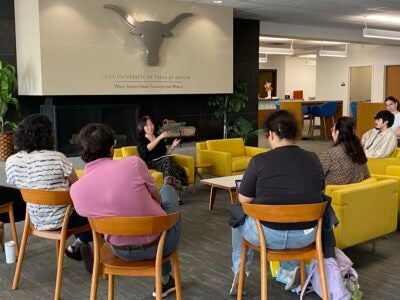
The Fall 2026 Lunch & Learn series, presented by the Moritz Center for Societal Impact, continued with Namkee Choi, Ph.D., discussing evidence-based depression treatment for older adults.
Her primary research focuses on depression in late life and improving depression treatment for low-income homebound older adults. One of her earlier National Institute of Mental Health-funded studies was the first to test the feasibility and efficacy of delivering therapy to homebound adults through inexpensive and accessible video conferencing. Subsequent studies by Choi and her team have explored the real-world effectiveness of lay mental health providers and telehealth delivery for older adults who are underserved by the existing mental health service system.
During the discussion, Choi shared that while antidepressant medications are among the top five medications most commonly prescribed to older adults, after statins, antihypertensives, antidiabetic medications and gastrointestinal medications, they are not highly effective, as medications do not solve age-related and other problems. Combining pharmacotherapy and talk therapy is more effective for depression in older adults. Depression treatment for low-income older adults also needs to be accompanied by case management services for other independent living needs.
Choi also discussed the high level of dpression-related stigma and the need to normalize depression as a treatable health problem. “Life can be depressing. We don’t have to be stigmatized,” she said. “The symptoms [of depression] are treatable.” Choi also pointed out that for older adults, depression treatments can also help with memory and executive function issues.
An additional complication in the treatment of older adults, according to Choi, is the shortage of social workers and licensed social workers who want to work with older clients. Choi’s team is working to close that gap by testing the clinical and cost-effectiveness of telehealth and fall prevention delivered by lay counselors and coaches.
Choi’s social work practice experience has included advocacy for and direct work with long-term care residents and homebound older adults.
The Lunch & Learn series provides an informal space for students, faculty and staff to explore research topics and foster collaboration. The next Lunch & Learn event will be held 11:30 a.m. – 12:30 p.m. on Wednesday, Nov. 11 with Dr. Mercedes Hernandez discussing “Family Care & Well-being in Serious Mental Illness: Insights from Latinx Families in Texas.” The event will be in Walter Webb Hall 246. Light snacks and drinks are always provided and registration is not required.