

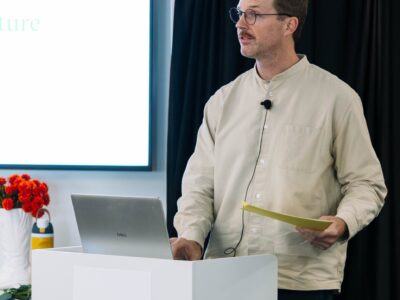
Walter Webb Hall was full on Oct. 2 for the 17th annual Sue Fairbanks Lecture, where Kevin Barrett, LCSW, led a discussion on psychedelic therapies.
Barrett, a therapist and lecturer at the University of Chicago Crown School of Social Work, Policy and Practice, has used psychedelics in his work with clients for six years. In his lecture, titled “Holding, Containing, Dissolving: A Psychoanalytic View of Psychedelic Therapies,” he examined the clinical, theoretical and ethical questions that arise when psychoanalysis and psychedelic therapy intersect.
He started with the basics, laying out foundational psychoanalytic concepts and terms before walking attendees through a brief history of psychedelics and the rules that govern them today. Psychedelic drugs remain illegal under federal law. Spravato, a nasal spray made with a form of ketamine, was approved by the FDA in 2019 for treatment-resistant depression.
In psychoanalytic work, internal working models resist change and shifting them takes repetition and revisiting. Psychedelics, Barrett said, can get a person there quicker. Ketamine’s dissociative effect can make someone more open to the changes that come from therapy, much as critical periods in learning open the door to new skills. A critical period opens after a stroke, and in children, these periods make it easier to pick up something like language.
Barrett described the effect as a new layer of snow. The old ruts are still there underneath, but you can imagine a new path. He was candid that researchers don’t yet know the exact mechanisms at work.
Sue Fairbanks (MSSW ’81) attended the lecture and actively participated in discussions. The annual lecture is supported by the Sue Fairbanks Endowment for Excellence in the Application of Psychoanalytic Knowledge in Social Work.