

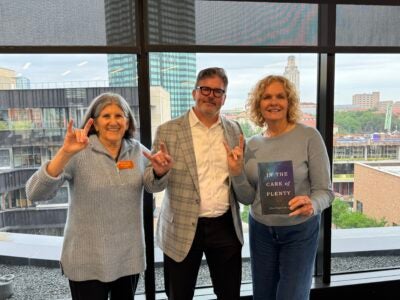
Jan Neis was 21 years old when she got her first real estate license. She learned the family land development and property management business from the ground up, in Florida, the New York Tri-State area, then Milwaukee, where she led commercial leasing and oversaw more than 3,500 apartment homes across two family businesses.
She and her husband were foster parents. She organized community events for people experiencing poverty and homelessness in Milwaukee. They were big affairs. She would transform a high school cafeteria into a five-star dining experience with tablecloths and a piano player for guests from the Milwaukee Rescue Mission, a non-profit that serves the homeless and hungry with food, shelter and care.
Life changed when she was 40 and lost her husband. She continued raising their three children alone, two of whom were adopted from Russia.
Once her children were grown and starting their own lives, retirement wasn’t the right fit. “I have a tendency to freeze if I’m just left to my own self,” she says. “But if I’m collaborating — if we’re bouncing ideas — I have energy.”
A Broader Lens
The Tower Fellows Program gave her that community. Neis found it when researching immersive Spanish language programs. The program is a two-semester program at UT Austin gives adults in-person access to courses alongside students, faculty and a curated community of peers at a similar life stage. Neis submitted her application within 48 hours. In a week, she was on a plane to Austin to explore the campus.
Each fellow pursues their own interests with the support of a faculty mentor. Neis explored topics from positive psychology to death and dying to Victorian literature.
She was looking, she says, for a broader lens on life’s challenges. She found it in her second semester, when she enrolled in Dean Allan Cole’s “Persons, Pain, and Resilience” course, a small undergraduate seminar that explores the human experience of physical, emotional and spiritual suffering through the lenses of humanities, social work and medicine.
Dean Cole shared his own story of living with young-onset Parkinson’s. His teaching assistant talked about her challenges, and the students opened up about grandparents, fathers, grief. “People were comfortable sharing,” Neis says, “because right away the professor is sharing, the TA is sharing.”
In the class, Dean Cole noticed that Neis had the grace to step back and let students speak and knew when to step forward. “He didn’t even know what he taught me in that moment,” she says. “It stayed with me.”
The class also read books and talked with the authors about their experiences, in person or via Zoom. One author she remembers is Avrel Seale, a UT writer and editor who lost the use of one hand after a major stroke in 2018. He played guitar for the class. “I’ve never heard or seen anything like that,” she says. “He could still hit those chords. It was beautiful.”
Seasons of Pain and Resilience
As a child, Neis walked a friend through leukemia. Her friend survived, and the experience left an impression. Another friend was killed in a car accident, then she lost her mother, then her husband. “I’ve always bristled when people use the word tragic,” she says. “I don’t want to attach that language. It’s not that I’m in denial. I get the hardship for sure.”
Months later, Neis was still thinking about what the course gave her. “Simply holding a paintbrush doesn’t make someone a painter,” she wrote. “In the same way, simply having the ability to speak and hear doesn’t necessarily mean we’ve learned to listen and be fully present with another person.”
Presence, she reflected, calls on curiosity, thoughtful listening, reflection and a willingness to honor another person’s story. “Their stories and wisdom have become companions I now carry with me,” she wrote. “They offer a reservoir of perspective I can draw upon when life presents its own seasons of pain and resilience.”
After completing program, Neis has kept going, part-time now, pursuing what she calls projects that “create opportunities for shared experiences and meaningful conversations that foster connection, deepen understanding, and help people discover that we all matter.”
Her sister joined the program in January — after visiting for a wine dinner, sitting in on all four of Neis’s classes and flying home to apply immediately. Just like Neis.