

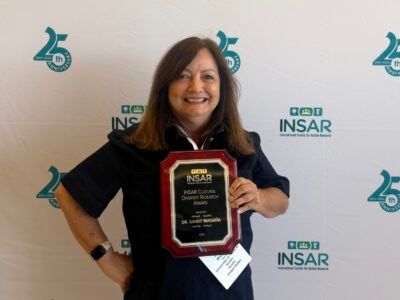
In recognition of Autism Acceptance Month, Sandy Magaña, Ph.D., has been sharing her research on disparities in autism care with national and international audiences — and picking up a major international award along the way.
Magaña, professor in autism and neurodevelopmental disabilities and executive director of the Texas Center for Disability Studies, received the Cultural Diversity Research Excellence Award at the 2026 International Society for Autism Research Annual Meeting in Prague.
Her research centers on the cultural context of families who care for people with autism and intellectual and developmental disabilities across the lifespan. What works for one family may not work for another, and the gap between evidence-based practice and lived experience can be especially wide for Latino, Black and other families navigating systems that weren’t designed with them in mind, according to the evidence in her research.
“Coming from a social work background, I’m already thinking about the perspectives of the people who are being affected by the problems versus some professional coming in with a top-down approach,” said Magaña.
That perspective shapes her best-known intervention, Parents Taking Action, a peer mentor program that trains parents of autistic children — in their own language and cultural context — to navigate systems, advocate for services and support their child’s development. The program has been adapted for Black, Chinese American, Korean and Navajo families, among others.
Her research has also documented gaps in care. Latino and Black autistic children receive lower quality healthcare than their white peers, her work finds — not because providers intend harm, but because cultural context often goes unaddressed.
“Providers aren’t aware that they’re treating people in a biased way,” Magaña said. “They may not be learning about the cultural issues of the people they’re serving.”
Magaña recently joined the SiriusXM program Health Equity Now and the UC Davis MIND Institute’s Science MINDS podcast, available here, to discuss her research with national audiences.