

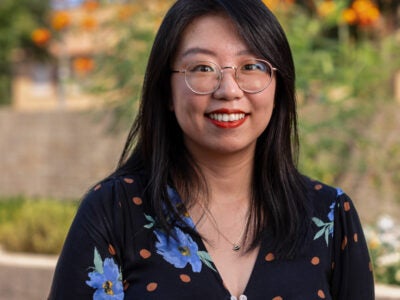
Doctoral student Xiaoyi Zeng recently received the Graduate School Office of Career and Life Design’s 2026 Reimagining Professional Development Award, marking a new funding award among UT Social Work doctoral students.
The award supports her team project, “Professional Development and Interdisciplinary Collaboration for the Future Aging Workforce,” and highlights the important leadership role of social work in shaping the future of aging research and practice.
Zeng brings 10 years of experience serving older adults as a community social worker and former dementia caregiver. Before beginning her Ph.D. at UT Social Work, she coordinated dementia evaluations and clinical interviews at Mount Sinai’s Alzheimer’s Disease Research Center, developed culturally responsive tools for bilingual teams, and led community education efforts to raise awareness about brain health and mental health.
Zeng continues to connect research with real community needs. She is leading a community-engaged initiative, “Creating Dementia-Friendly Neighborhoods,” which focuses on reducing loneliness and social isolation through practical, community-driven solutions.
“Aging is not just a biological issue. It affects families, communities, health systems, and public policy,” Zeng said. “Social work has always worked at the intersection of these systems. That is why social work is well positioned to help lead collaborative efforts in aging.”
Across UT, graduate students in more than 12 colleges and schools are interested in aging research, yet training opportunities often remain siloed within departments. Zeng’s project aims to create sustained, structured spaces where graduate students can learn across disciplines, build research collaborations, and prepare for careers in the rapidly changing aging field.
The initiative will develop clear career roadmaps spanning academia, industry, nonprofit organizations, government, and entrepreneurship. It will also create forums where students can share work in progress, receive feedback from different disciplines, and build mentoring relationships. By strengthening collaboration early in graduate training, the project seeks to prepare students to become researchers and future leaders who can turn knowledge into action.
“Graduate students are the future aging workforce,” Zeng said. “If we train them to think across disciplines and stay connected to community needs, we can accelerate meaningful change in how society supports older adults.”
The project builds on the work of the Texas Aging & Longevity Consortium Graduate Student Council, where Zeng serves as president, and reflects the School of Social Work’s commitment to community impact. Zeng hopes to bring new knowledge, partnerships, and practical innovations back to local communities, ensuring that research remains grounded in lived experience.
“Small changes in how we design services, neighborhoods, and policies can make a real difference in older adults’ daily lives,” Zeng said. “I am grateful for this award and excited to see how social work can lead collaborative efforts and connect research to real impact.”