

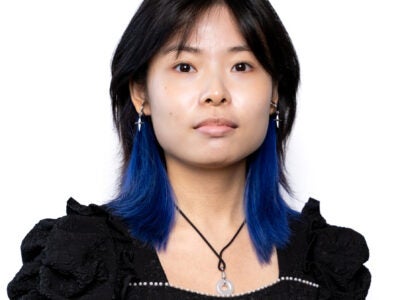
Meiyan Chen, a doctoral student at the School of Social Work at The University of Texas at Austin, was named as a 2026 Health Equity Scholar by the American Psychological Oncology Society (APOS).
The two-year scholarship award helps support Chen’s work with cancer patients, particularly those that have not necessarily been heard from or studied in prior studies.
“My research addresses multifaceted barriers such as financial hardship to social isolation to cultural misalignment, all of which shape mental health outcomes among adolescent and young adult cancer survivors,” Chen said. “This program provides the critical platform and mentorship needed to further psycho-oncology research and build better models of care for survivors.”
Chen, who earned her bachelor’s degree from Huazhong University of Science and Technology and her master’s of social work from the University of Michigan, began her interest in healthcare models after observing differences in health outcomes based on socioeconomic status. She previously worked in Michigan Medicine’s Adolescents and Young Adults Oncology program, where she developed skills in combining social work research with behavioral health interventions in clinical settings.
She also has worked as a research assistant contributing to several studies with a focus on socio-economic and technological factors influencing health outcomes for cancer patients, employing systematic review and a meta-analysis approach.
Currently, Chen is working under the mentorship of Dr. Lailea Noel, whose community-based research approach aligns with Meiyan’s goal of conducting empirical research to bridge the gap between research and practice. Her work aims to identify potential resources and possibilities for societal growth within existing social structures.
“We’re incredibly proud of Meiyan’s scholarship and excited to see it be further validated through this award,” said Dr. Yessenia Castro, director of the doctoral program at UT Social Work. “Her research in psychosocial oncology has the potential to build better healthcare systems, and with those insights, we get to improve lives through innovative social work science.”