

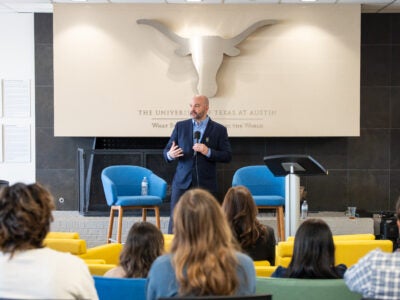
On Veterans Day, COL. (Ret.) Nathan Keller, Ph.D., LCSW, brought both scholarly expertise and frontline experience as the Fall 2025 speaker for UT Social Work’s Distinguished Speaker Series.
During his guest lecture, Keller discussed the history of military social work, opportunities in the field, and how the values and practices of social work have benefitted enlisted military members.
A licensed clinical social worker and retired Army colonel himself, Keller traced the evolution of military social work while addressing a fundamental question: How do professions with vastly different tools find common ground to create better social outcomes?
The answer, he argued, lies in shared values.
“The military focuses on structure, discipline and serving the mission,” Keller explained. “Social work emphasizes empowerment, empathy and transforming individual lives.” The tools differ dramatically — one profession operates through command hierarchies, the other through therapeutic relationships. But both rest on shared commitments: loyalty, duty, respect and service to others.
That values alignment has powered military social work’s transformation from Civil War-era welfare checks into today’s sophisticated practices of veterans services, military family support, health and behavioral health, and post-traumatic stress treatment.
What began as basic transition support evolved through military conflicts. Keller spoke on how military social work treated shell shock in WWI trenches, managed widespread substance use during Vietnam, adapted to all-volunteer forces and family systems in the 1980s, and ultimately embedded behavioral health providers within combat units post-9/11. Each expansion reflected both changing warfare and a deepening understanding of service members’ complex needs.
Contemporary Practice and Pathways
Today’s military social workers assess and treat complex medical and mental health conditions, assist transitions from active duty to civilian life, prevent homelessness, and provide case management and crisis intervention across care continuums, Keller said. They work extensively with physical and traumatic brain injuries, PTSD, moral injury and family system challenges that emerge from repeated deployments.
The work also demands specific competencies: understanding culture and experience; providing care aligned with that culture; advocating effectively within systems; and navigating specialized resources. Cultural competence proves critical, as many challenges stem directly from service experiences unique to military life.
UT Social Work prepares students for this specialized practice through its Certificate in Military Social Work Practice, developed in partnership with the Institute for Veterans and Military Family Wellness — a collaboration between the School and Dell Medical School led by Dr. Elisa Borah. The certificate program includes an anchor course in Social Work with Military Personnel and Families, specialized practicum placement in military-focused settings, relevant elective coursework and 20 hours of professional development centered on military populations.
Keller closed with reassurance to students considering military social work, “You don’t have to be an expert on everything — just on people, empathy, empowerment and service.”
That expertise, grounded in social work’s core values, continues to drive impact for service members, veterans, and their families navigating some of life’s most challenging transitions.